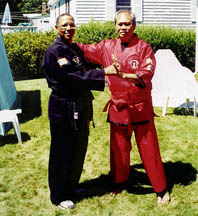
Karazenpo Go Shinjutsu is the name that Victor "Sonny" Gascon
gave to the portion of Shaolin Kempo which he organized in the late 1950's
(see history page). By organizing Kempo into
specific forms, combinations, etc., Sijo Gascon created a system that could
be taught and passed on effectively. The name Karazenpo Go Shinjutsu
means: Kara - for Karate or empty; Zen -
for the mind arts; Po - for Chinese Kempo or boxing; Go
Shinjutsu - for school of self-defense.
Specifically, our basic curriculum includes forms (1-5 kata, 1-5 pinan, Statue of the Crane), blocking systems (8 point, 10 point, plum tree), combinations (1-26),Kempo punch techniques, and self defense techniques (empty hand, knife, club).
Weapons studied by Karazenpo Go Shinjutsu schools tend to vary slightly. Typically, the study of weapons is reserved for advanced ranks. At Duncan's Martial Arts Academy, we study the Fillipino art of escrima, the Chinese broadsword and bo, the Okinawan kama, sai, and bo,and the Japanese sword. Most of these weapons are only taught at the black belt level.
As with many martial arts systems, the five animals (Tiger, Leopard, Snake, Crane, Dragon) are an important part of the program of study at Duncan's Martial Arts Academy. Students not only learn why we study the movements of these animals, but also many techniques which utilize each animals strengths. Below, you will find a chart outlining the specific
requirements of each rank.
Student Curriculum Guidelines
| Rank |
Combinations |
Kempos |
Forms |
Historical Info |
Weapons |
Misc. |
White
6th Rokkyu |
6 & 7 |
1 Basic |
8 point blocking |
What & Who is Duncan's Marial Arts Academy? |
none |
White Gi |
Yellow
5th Rokkyu |
3 |
2 Basic |
1 Pinan
8 point blocking w/ strikes |
General Kempo History |
none |
White Gi |
Orange
4th Rokkyu |
2 & 5 |
2 Basic |
2 Pinan |
Kempo vs. other styles |
none |
White Gi |
Purple
3rd Rokkyu |
8 & 9 |
2 Basic |
1 Kata
Begin Statue of the Crane |
What are Kajukenbo and Karazenpo Go Shinjustu? |
none |
Full White or Black Gi |
Blue
2nd Rokkyu |
4 & 18 |
2 Intermediate |
2 Kata
Finish Statue of the Crane |
Historical Terminology |
none |
Full White or Black Gi |
Blue/Green
1st Rokkyu |
10 & 26 |
2 Intermediate |
3 Pinan
10 point blocking |
Who was Bodhidharma? |
Basic Bo and/or Kama |
Full White or Black Gi |
Green
Gokyu |
1 & 12 |
2 Intermediate |
3 Kata |
Who was James Mitose? |
Basic Bo and/or Kama |
Tiger Technique |
Green/Brown
Yonkyu |
11, 14 & 15 |
1 Intermediate
1 Advanced |
4 Pinan |
Who was William K.S. Chow? |
Basic Bo and/or Kama |
Leopard Techique |
Brown 3rd
Sankyu |
17 |
2 Advanced |
4 Kata
5 Pinan |
Who are Adriano Emperado & Victor "Sonny" Gascon? |
Basic Bo and/or Kama |
Snake Technique |
Brown 2nd
Nikkyu |
19 & 16 |
2 Advanced |
5 Kata
Begin Plum Tree Blocking |
Who are S. George Pesare and Nick Cerio? |
Basic Bo and/or Kama |
Crane Technique |
Brown 1st
Ikkyu |
13 & 20 |
2 Advanced |
6 Kata (optional)
Finish Plum Tree Blocking |
Who is James Bryant? |
Basic Bo and/or Kama |
Dragon Technique |
Shaolin Animal Influences:
- Tiger
- We study the Tiger to gain insight into the awesome strength and tenacity of this great cat. Strength can be defined as the ability to endure great hardship. Tenacity is the driving force within that refuses to quit until a goal is reached. It is said that when two tigers fight, one dies and the other is wounded. This demonstrates the degree of tenacity possessed by the Tiger. By focusing a high degree of power into your strikes during basic class drills, you can begin to develop the inner strength (Chi) of the Tiger. Don't waste the opportunity that the basic "line drill" portion of class affords you. Remember that you will likely be unable to defend yourself in a real situation if you practice with little intensity.
- Leopard
- We study the Leopard in an attempt to possess its incredible speed. The Leopard uses its speed and agility to totally devastate its opponent before their defenses have the opportunity to be deployed. One often overlooked aspect of the Leopard is its ninja-like stillness when on the prowl. When Master Joe Salomone visited Duncan's Martial Arts Academy in early 1999, he stated "real speed comes from being quiet. When you are internally and externally still, there's nothing to block the focus of your movement and thus that movement will be very fast". This is one of the reasons that we often meditate prior to class. Though true meditation requires a longer period of time of time than we can allow, we introduce you to the experience so that you may develop the skill on your own. Learn to be quiet and learn to be quick!
- Crane
- The Crane is nature's graceful ambassador of flight. To be so awkwardly built, yet appear so smooth in movement requires balance beyond belief. A cat may seem graceful, but remember that a cat is built for efficient movement. A Crane exhibits amazing grace and balance with a body that is awkwardly constructed. The one legged resting stance preferred by many members of the Crane family is the cornerstone of our kicking system. As the Crane stance goes, so goes the kick. The Crane's wing is also imitated by the Kempo practitioner (combinations 1 and 18, as well as 3 pinan) as both a block and a strike. One who imitates the Crane will possess the power and grace that comes from good balance.
- Snake
- We study the Snake because of its uncanny ability to fight from the ground. The Snake is an excellent example of turning one's weakness into strength. Unable to stand, punch, or kick, the Snake would seem to be doomed to the role of prey rather than predator. The Snake, however, focuses on the abilities it does have. The ground is home to the Snake, thus it excels in grappling situations. Once the fight is on the ground, the Snake uses its flexibility to wrap up and confuse its opponent. Most individuals are quickly disoriented when on the ground, panic sets in, and the Snake emerges victorious. Every student who enters our Dojo has their own unique abilities. One should try to find these abilities and refine them, then, like the Snake, find ways to make others adapt to your strength.
- Dragon
- We study the Dragon to better understand its legendary spirit. Mythical battles between super human knights and fierce Dragons often speak of the Dragon's steadfast refusal to give up. Even though the battle often ended in the death of the Dragon, it is the incredible will to continue the fight against all odds that is to be emulated. The spinning tail of the Dragon is seen in our spinning techniques, both with our hands and feet. If you use the fighting spirit of the Dragon to sustain you when you reach a point where you feel like you cannot continue, you will likely emerge successful.